
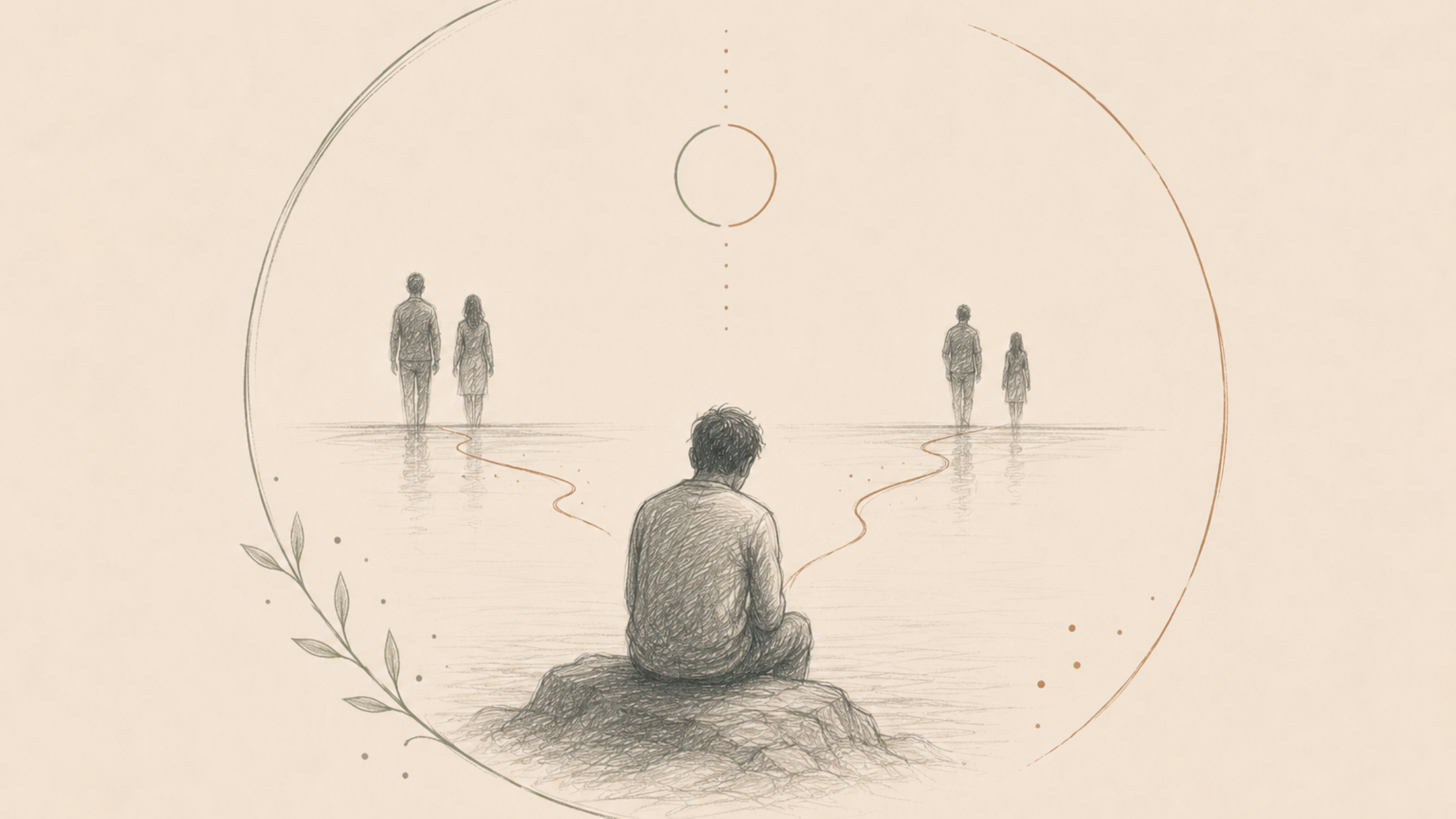
A name comes up in conversation, or a photograph surfaces somewhere, and something shifts in you that you can’t immediately place. Not sadness exactly. Something closer to a small drop in pressure.
You haven’t spoken to this person in two years. There was no argument, no falling out, no moment you could point to. You’d have called it a good friendship if anyone had asked, right up until you noticed it had quietly stopped being one.
The feeling passes in a few seconds, because nothing in your vocabulary catches it. Then you go back to what you were doing.
Why it never gets called grief
Grief is a word most of us reserve. It belongs to funerals, to endings that announced themselves, to losses other people can see. There are rituals for those. People know to bring food, to send a message, to ask how you’re holding up.
There’s no ritual for a friendship that dissolved without anyone deciding to end it. Nobody sends a card when a relationship thins. There’s no occasion for the fact that someone who used to know the current state of your life now knows a version of you that’s three years out of date, and neither of you did anything wrong.
The feeling is the same, though. The sadness, the longing, the particular hollowness of something being absent that used to be present. What’s missing isn’t the grief. What’s missing is anywhere to put it.
What it does while it’s unnamed
Unnamed grief doesn’t disappear. It reroutes.
It comes out as irritability with no obvious cause, or a low flatness that doesn’t lift when circumstances improve, or a tiredness that has nothing to do with sleep. It shows up as a nagging sense that something is off, which gets filed under stress or overwork and left there.
Occasionally that filing is accurate. More often it’s a loss you never gave yourself permission to call one, surfacing in the only form available to it.
The efficiency you bring to everything else doesn’t work here. You can manage past a great many things in a life. This isn’t one of them, because it isn’t a problem waiting for a solution. It will keep sending up small, strange signals until someone acknowledges what they’re about.
What mourning is actually for
There’s a common assumption that mourning is how you let go of something. Work through it, get to the other side, move on.
That isn’t really what it does. Grief is closer to the shape love takes when what it loved is no longer available in the usual way. It doesn’t move you away from the lost thing. It keeps you in relationship with it, and it insists the thing was real.
Which means mourning a faded connection isn’t about closing a file. It opens a question that turns out to be useful: what was actually in there? What quality of ease or recognition lived in that friendship that doesn’t live in the ones that replaced it?
The question leads somewhere, though not backward. The past isn’t recoverable, and trying to reconstruct it exactly becomes its own kind of distance from the present. What it leads to is more specific than that. Sometimes it’s an ache for one particular person, which is information you can act on. Sometimes what you’re missing turns out not to be the person at all, but a way of being with someone that you haven’t had in years and had stopped believing was still available to you.
Naming it
None of this requires a conversation or a decision or any action at all, at least not yet.
It requires one thing, and it’s harder than it sounds. Saying it plainly, even if only to yourself: something mattered here, it isn’t as present as it was, that’s a real loss, and I’m allowed to feel the weight of it.
That sentence is difficult because it removes a small comfort you’ve been living inside. As long as the loss stays vague, it stays manageable. Name it and it becomes real in a way that costs something.
But what stays unnamed also stays lodged, rerouting into flatness and tiredness and the vague sense that something is off. What gets named can begin to move.
So the next time it arrives, that small drop in pressure when the name comes up, try not to let it pass in three seconds. Stay with it a minute. You don’t need to work out whose fault it was or what to do about it.
You’re allowed to miss someone who isn’t gone. Who’s alive, and well, and probably still fond of you, and simply isn’t in your life the way they used to be. That’s a real thing to have lost, and most people carry two or three of them without ever once saying so out loud.
Leave a Reply