
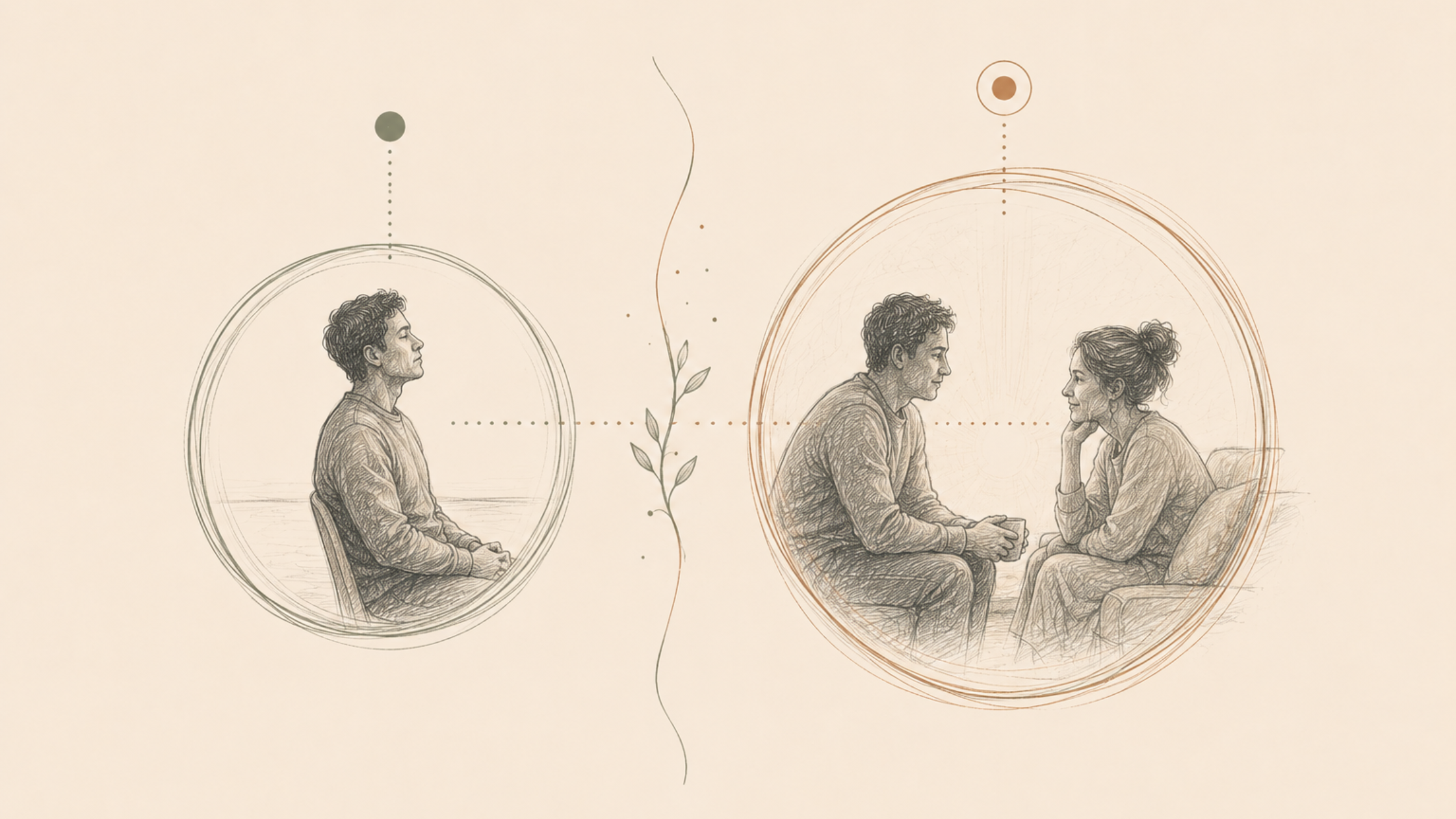
There’s a kind of strength that looks, from a distance, exactly like the real thing.
It presents well. It holds under pressure. It knows how to manage a room and keep its tone level while everyone else’s is rising. People who carry it get described in a particular vocabulary: reliable, steady, the one everyone leans on. The one who always seems fine when nobody else is.
From the inside it feels like competence, and partly it is. It’s also the accumulated skill of someone who learned, early or gradually, that their own difficulty was best handled privately. That composure was what the room required. That the shape they took, the capable one, the one who didn’t add to the weight of things, was what made them worth having around.
When a resource becomes a requirement
None of this is an argument against steadiness. Staying present under pressure without being dismantled by it is genuine and hard-won.
But there’s a difference between composure you can choose and composure you can’t put down. The first one is a resource. The second is a constraint that happens to look identical from outside.
Someone who can’t be seen struggling isn’t someone without struggles. They’re someone whose struggles have nowhere to go. Everything gets processed inward, alone, and returned to the surface in the only permitted form: handled.
That containment isn’t passive. It’s ongoing, invisible work, and it settles into the body as a low-level tension the person carrying it usually stopped noticing years ago. It doesn’t register as effort anymore. It registers as their resting state. Which means the always-composed person is, in a real sense, always working, including in rooms where nothing difficult is happening at all.
The loneliness of being the capable one
The people around you often don’t know anything is being carried. Not because they don’t care. Because the performance has been so consistent, for so many years, that it left no room for the knowledge. They took their cue from what was offered, and what was offered, reliably, was fine.
This is the quiet transaction of composure. It keeps other people comfortable at the cost of keeping them at a specific distance. The relationship stays warm, often genuinely warm, but it stays in one register: the one where you don’t need anything. And the part of you that does need gets quieter over time, until eventually it stops surfacing.
Years into a stretch when things were going well by every visible measure, someone asked me directly how I was carrying it all. Not how things were going. How I was carrying it. I gave an answer that was true, measured, and complete, the version that required nothing of them. Walking away, I had the very specific sensation of having been handed an opening and declining it with considerable efficiency. Nobody noticed. The conversation had been warm. And I had been, in some quiet and precise way, entirely alone in it.
What you take from people by never needing them
When you never let anyone witness your difficulty, you also never let them be genuinely useful to you. Not helpful the way capable people are helpful to each other. Useful in the more intimate sense: needed, trusted with something fragile, turned to by someone who couldn’t hold it alone.
Being trusted that way is one of the main routes anyone has into feeling close to another person. The relationships people call their most meaningful are almost always the ones where both people have been seen in difficulty, not only in success. That shared exposure isn’t incidental to the closeness. Very often it is the closeness.
So when one person never reaches for support, the whole thing organizes itself around an inequality neither of them chose. One carries. The other is carried. It’s comfortable and familiar, and it forecloses the particular depth that only shows up when both people have been seen in the same honest light.
Admiration holds people at a distance, because the distance is what keeps the image intact. Love asks for something closer.
When it stops being something you do
At some point composure stops being a thing you do and becomes a thing you are.
The shift is gradual. It happens through repetition and reward, through the accumulated experience of being valued for steadiness, of being the person others describe as unflappable. Those experiences are real, and they build something. What they build can also become a kind of cage, an identity so firmly organized around capability that the person inside it can no longer quite reach the registers outside it.
You can tell when this has happened by what a simple question does. Someone asks what you need, and instead of an answer there’s a brief blankness, because the honest answer has been waiting so long and grown so large that it can’t be said quickly.
None of this is an argument for dismantling something that took years to build. The composure served a purpose, and in plenty of rooms it still does.
But there’s a version of this that costs almost nothing. Ask one person for something small, something you could easily have handled by yourself, and let them do it. Not a confession. Not the whole weight. Just one thing set down, in front of someone who has been waiting a long time to be allowed to help, and has never once been asked.
Leave a Reply