
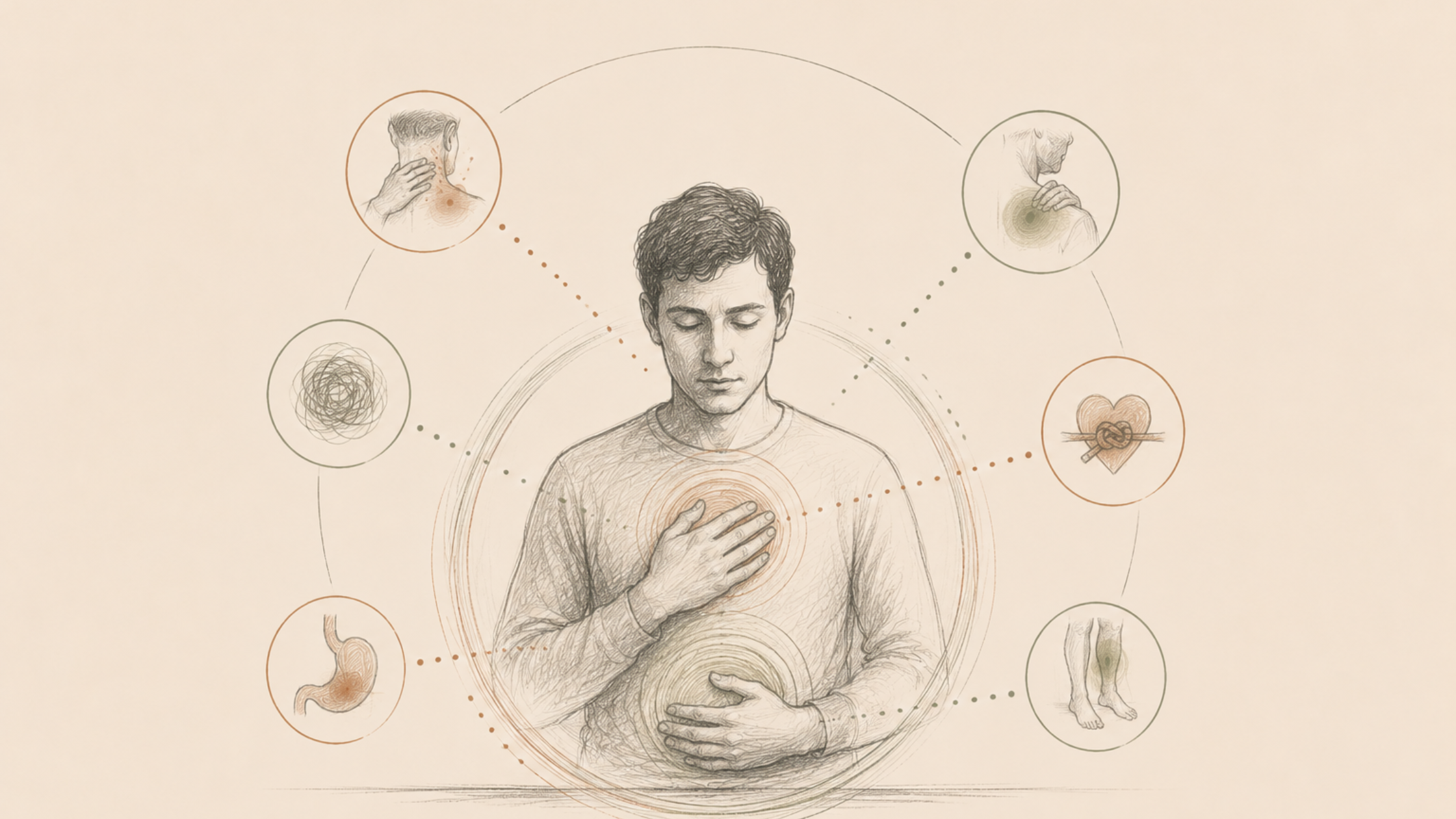
In the practice I’ve spent years building, there’s a starting assumption that most of Western medicine arrived at only recently, and often reluctantly: the body and the mind were never two separate things pretending to be one. A knot in the stomach isn’t the body malfunctioning while the mind, elsewhere, holds the real information. The knot is information. Often it’s the first information you get, arriving before you have words for whatever is producing it.
Most of us were taught to think about the body differently, as a kind of vehicle. Something you maintain and troubleshoot when it breaks down. The mind does the understanding. The body does the carrying. It’s a tidy division of labor, and it’s mostly wrong.
The body speaks first
Before you can say what’s wrong, the body already knows. The shoulders that climb toward your ears halfway through a conversation you didn’t realize was difficult. The stomach that tightens before you’ve consciously registered what you’re dreading. The sudden tiredness that shows up not at the end of a long day, but the moment someone says the one sentence that confirms a fear you hadn’t admitted to carrying.
We notice these signals occasionally, usually when they’re loud enough to insist on it. Mostly we translate them into something more manageable and far less informative. Stress. Tiredness. Too much coffee. The label arrives fast, and the actual message underneath it goes unread.
What gets lost in translation
This isn’t a failure of discipline. It’s closer to a learned skill: converting a precise signal into a vague one, because the vague one is easier to carry through a day with no room for the precise version.
The body doesn’t stop sending the signal just because you’ve stopped reading it accurately. It keeps talking, just in a coarser dialect. Not the specific tightness before one hard conversation, but a low-grade tension that’s been there so long it no longer registers as tension. It just feels like your resting state.
The body keeps the account
There’s a particular exhaustion that has nothing to do with how much you slept. It shows up after an evening that went, by every visible measure, well: warm company, easy conversation. You come home more tired than when you left, and you can’t account for it, so you file it under a long week, or getting older.
Sometimes that’s exactly what it is. And sometimes it’s the body reporting something the mind was too busy to register: that something it expected to receive in that room, the sense of being genuinely met, wasn’t quite there. The surface of the evening was intact. Something underneath it didn’t land. The body noticed before you did, and it’s been trying to tell you since.
Coming back into contact
The posture I keep returning to isn’t a technique. It’s closer to a habit of attention: coming into contact with the body the way you’d come into contact with someone you were actually trying to understand. Not managing it, not optimizing it. Just being present with what’s actually there.
This is smaller than it sounds and, for most people, considerably harder. It means pausing in the middle of something ordinary, not to stop doing it, just to notice for a few seconds what’s happening underneath. Where there’s tension you’d stopped registering. Not to fix it. Just to receive it, the way you’d receive something a friend finally worked up the nerve to say.
Do that consistently, and what changes isn’t the content of what the body is saying. It’s your relationship to hearing it. The signals that have been waiting, patient and repetitive, get acknowledged instead of managed past. And a nervous system that’s been shouting to be heard tends to quiet down once it actually has been.
The body has never stopped talking
It was never the quiet one in this relationship. We were.
Every difficult feeling you moved past without fully feeling has been logged somewhere, quietly, waiting for the moment you’re finally ready to read it back.
That moment doesn’t need a retreat or a dramatic reckoning. It needs something much smaller: a few seconds, a few times a day, of actually listening to what’s already being said.
Leave a Reply