
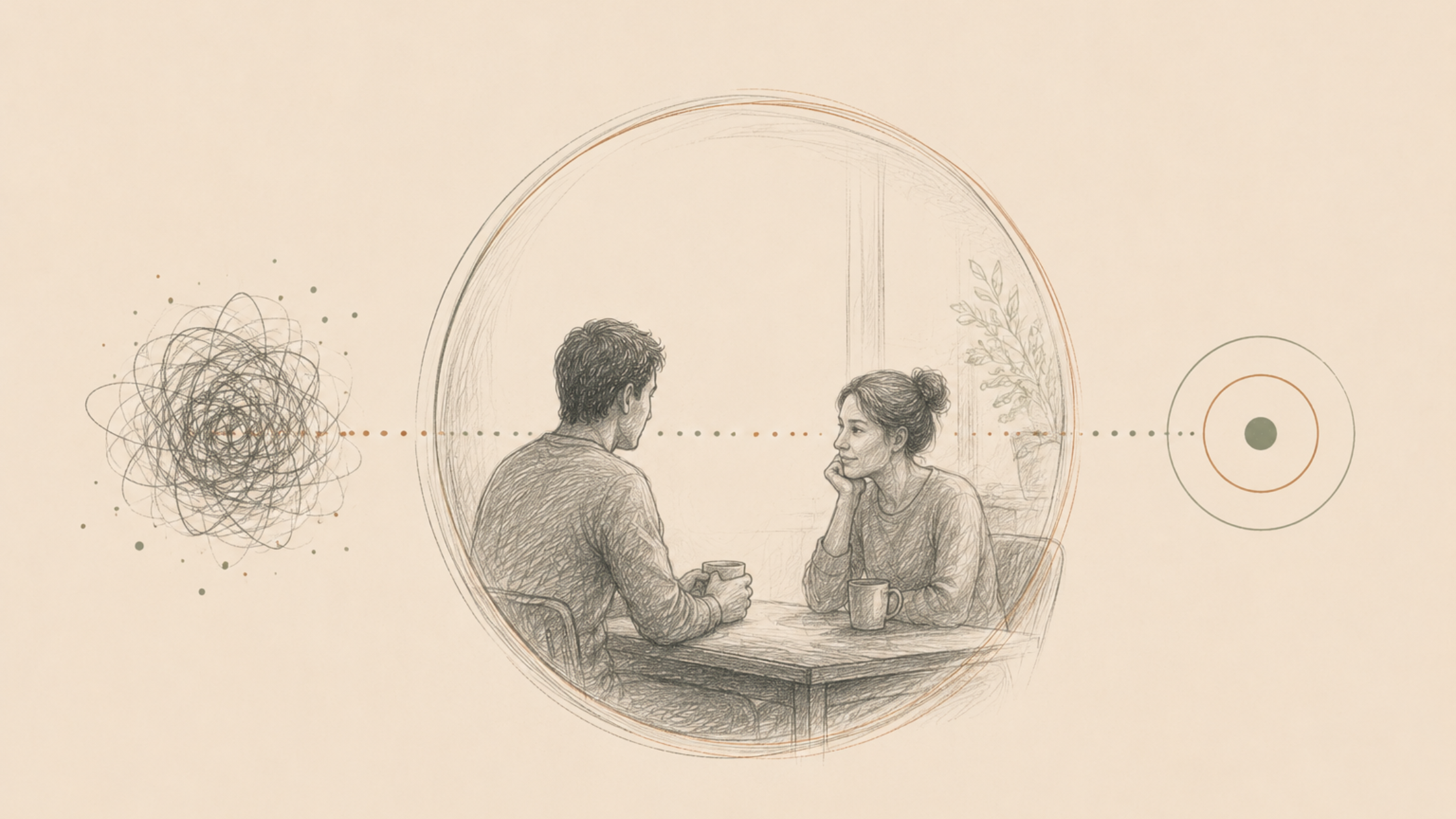
Someone asks how you are. In the half second before you answer, something sorts through what’s true and picks out the part that’s easiest to hand over. It sets aside the piece that would need explaining. What comes out is accurate, and lighter than the truth, and the conversation moves on.
Nothing was a lie. That’s the part worth sitting with.
I did this for years without knowing I was doing it. There’s a pause at the front door, before you go inside, where your face settles into whatever expression will be least alarming to the people in the room. A breath before you pick up the phone, in which the day gets rearranged into something more manageable. I’d have called these courtesies if you’d asked me. Mostly I wouldn’t have called them anything, because I didn’t know they were happening.
Why it doesn’t feel like hiding
Editing yourself before you arrive feels like consideration. It feels like maturity, even. Handle your own material first. Don’t hand people something they didn’t ask to carry.
And there’s real sense in that. Bringing every passing disturbance to every available person isn’t intimacy, it’s closer to the opposite. Discernment about who gets the full version of your week is a skill, not a defense.
But somewhere the self-management tips over into something else, and the tipping point is nearly impossible to see from inside. The edit gets so fast that the unedited version has nowhere left to go.
What the polished version costs
The people who love you can only love what they’ve been shown.
They form their attachment to the considered version honestly and generously, and they’re not wrong to. It is genuinely you. It just isn’t all of you. Meanwhile the part that didn’t make the edit waits somewhere out of sight, wondering whether it would be welcome if it ever showed up.
What happens over enough years is a kind of slow interior abandonment. A self that has to be edited in order to be acceptable eventually learns to abandon itself. It starts identifying with the edited version. It loses contact with the other one. Not through any decision, just through the long accumulation of it never quite being safe to appear.
I remember someone close to me asking, in different ways on different days, whether I was all right. Not urgently. With the quiet persistence of a person who could see past the surface and was leaving a door open. Each time I gave them something true and carefully selected: accurate in its facts, incomplete in its weight. They never knew how close they’d come to knowing. And I walked away with the particular loneliness of being asked directly and answering sideways.
What actually happens when you stop
Here’s what tends to surprise people, because the fear speaks so much louder than the evidence.
When someone lets the real thing come through, not as a strategy or a performance of vulnerability, just by stopping the edit long enough for something honest to get out, the other person doesn’t step back. Something in them moves toward you instead.
Not because the imperfection is charming. Because it’s real, and real things recognize each other. Everyone is carrying something unfinished. Everyone has a piece of themselves they’d leave out of the version they’d most like people to see. Showing the draft instead of the final copy isn’t revealing a deficiency. It’s showing that you’re a person, and it tends to meet a corresponding humanity that was also waiting to be let into the room.
This is different from confession, and it asks a good deal less. It’s just letting someone watch you in the middle of something, rather than only handing them your conclusions.
None of it works, though, without a corresponding gentleness on the other side. Most of us were taught that the right response to someone’s difficulty is to get them out of it: the solution, the reassurance, the reminder that things improve. Those are kindnesses, and in a moment of real exposure they’re also a way of not staying. What the exposed self needs isn’t improvement. It’s company. Someone sitting there without an agenda, without the faintly anxious helpfulness that sends the whole thing back underground.
The fear underneath the polish
The editing persists because underneath it, for most of us, is a fear that’s been around long enough to feel like a fact. That the unedited self, the one still in the middle of things, the one that needs something it hasn’t found words for, will turn out to be too much for whoever is on the receiving end.
That fear isn’t irrational. It was learned somewhere. From a disclosure met with discomfort instead of warmth. From the look on a face when a need got named plainly. From a relationship that cooled after something was offered the other person didn’t have the resources to receive. There’s evidence behind it, which is exactly what makes it so convincing.
What it doesn’t account for is how old the evidence is. How different this person, and this room, and this particular Tuesday are from the ones where the lesson was learned. The fear treats the past as though it were still the present.
It isn’t. And the correction doesn’t require a confession or a difficult conversation. It’s smaller than that: letting one answer be a single degree more accurate than it strictly had to be, and then staying in the room long enough to notice that nobody left.
Leave a Reply