
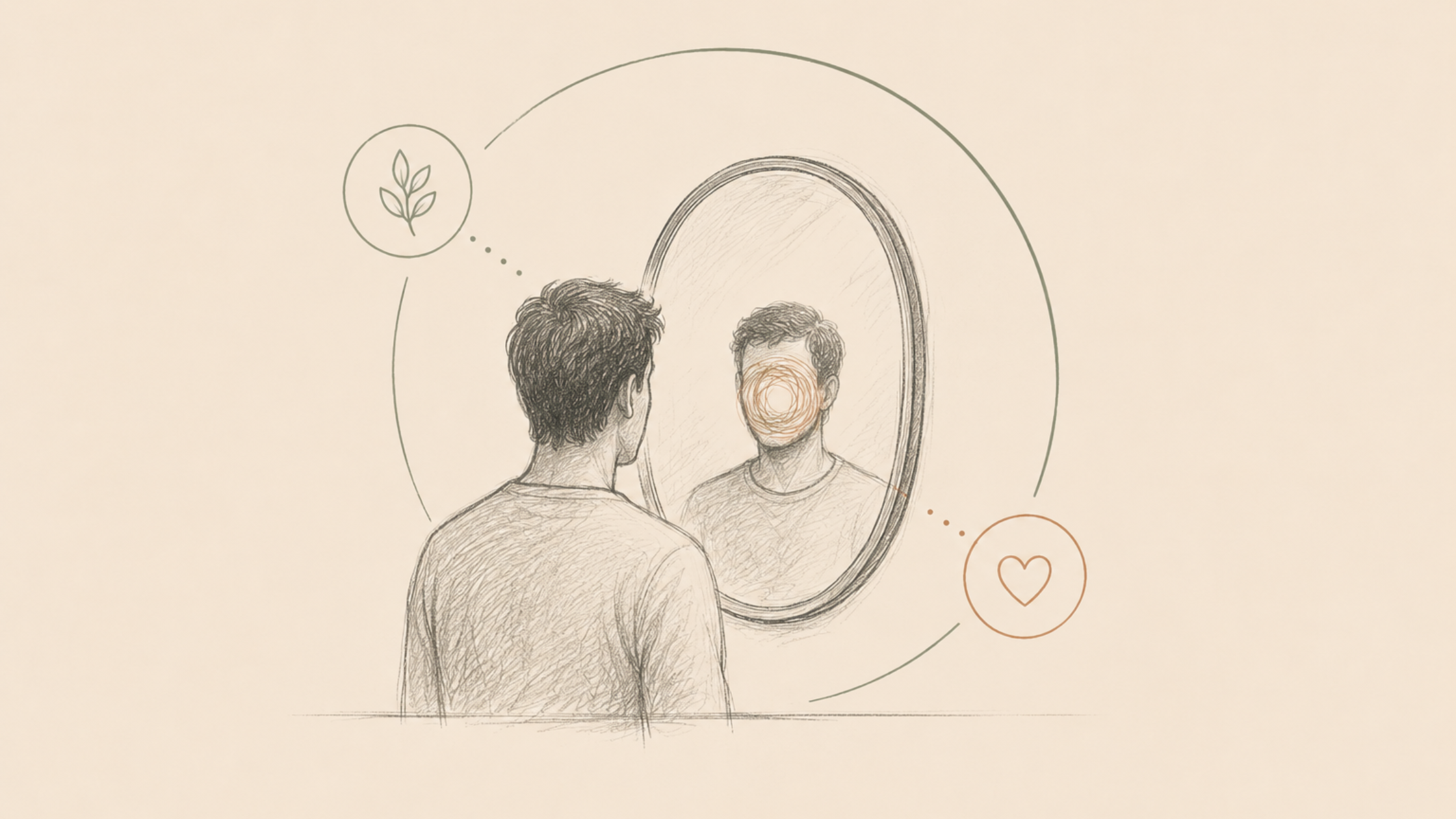
Most of us carry a picture of ourselves. It didn’t arrive all at once. It built up slowly, out of thousands of small reflections: the face someone made when we said something too loudly as children, the compliment we half-believed and then quietly filed away, the mistake that stayed with us far longer than the thing we did right. By adulthood, the picture feels less like something we made and more like a fact, the plain truth of who we are.
It isn’t quite that simple. The picture is edited. Not dishonestly, exactly, but selectively. Parts of us that fit neatly get kept on display. Parts that don’t fit get quietly minimized, until we barely recognize them when they resurface.
You’ve probably felt the gap between the picture and the reality without naming it. The moment mid-argument when you hear your own voice and realize it sounds exactly like something you promised yourself you’d never become. Or the compliment that lands and then, almost immediately, gets waved away, while the one piece of criticism from the same week gets replayed for days.
The two ways the mirror lies
For some people, the mirror leans harsh. The mistake gets rehearsed on a loop. The success gets attributed to circumstance, or timing, or other people being generous. This isn’t modesty. It’s a fluency, built over years, in believing the worst version of the story more easily than the best one.
For others, the mirror runs the opposite way. It’s built to be unshakeable, a version of the self so carefully defended that ordinary feedback, a piece of criticism, a small failure, feels less like information and more like an attack on the whole structure. This isn’t confidence. It’s protection dressed as confidence, and it costs something too: you can’t really be known by anyone, including yourself, if the image needs constant defending.
And for almost everyone, there’s a quieter third version. The self we present, the one that’s learned to manage the room and be useful, gets mistaken for the whole self. The parts that don’t fit that job, the tiredness that wasn’t convenient, the ambivalence about a life that was supposed to be exactly what you wanted, get pushed far enough off stage that they stop feeling like they belong to you at all.
Why looking harder doesn’t help
There’s a common assumption that seeing yourself clearly is a matter of toughness. That the obstacle is a kind of softness, an unwillingness to look at what’s uncomfortable, and the fix is to look harder, to be relentlessly honest with yourself the way a strict coach might be.
It’s almost exactly backwards. The parts of the self-image that are most defended are defended for a reason, usually because being seen clearly once felt genuinely risky. Confronting those parts with more force doesn’t loosen them. It confirms, once again, that looking is dangerous, and the defenses tighten in response.
What actually works is closer to the opposite of force: the same warmth you’d bring to someone else’s mistake, offered to your own. Not because your mistakes don’t matter, but because a mirror held with judgment shows you less, not more. People who can meet their own shortcomings with some patience tend to see themselves more accurately, because seeing is no longer something to brace against.
Why other people sometimes see it first
There’s a reason a friend can sometimes name a pattern in you before you can see it yourself. It isn’t that they have some secret access you don’t. It’s that they’re not invested in maintaining your particular story about yourself. They see the behavior plainly, without the explanation you’ve built around it, the one that’s had years to become convincing.
This is worth remembering the next time someone close to you says something about you that stings a little more than it should. It might be wrong. It’s also worth at least looking at directly before deciding that it is.
What changes when the mirror clears
None of this stays contained to the inside of your head. The picture you carry of yourself shapes the quality of attention you’re able to bring into every room you enter.
Someone at war with their own reflection tends to carry a low hum of self-monitoring into conversations, one that quietly limits how present they can actually be. Someone who’s made some peace with an honest, unedited picture of themselves, flaws included, tends to bring something calmer into the same room. Not because they’ve resolved everything. Because they’re not spending half their attention managing the gap between who they are and who they’re presenting.
You’ve probably felt this difference from the other side too. The friend who listens like they’ve got nothing to prove, versus the one who’s subtly performing even in casual conversation. The difference usually has less to do with how they feel about you, and more to do with how settled they are with themselves.
A small practice
Think of someone you genuinely care about. Hold the whole picture of them in mind, the real one, limitations included. Notice the quality of attention you naturally bring to that: patient, clear-eyed, without needing them to be different in order to be worth looking at closely.
Now try turning that same attention on yourself. Not approval, not judgment. Just the plain willingness to see what’s actually there.
Most of us extend that kind of seeing outward all the time. We understand, looking at someone we care about, that their harder edges usually formed for reasons, that a flaw from the outside often looks, from the inside, like the best available answer to a problem they didn’t choose.
We rarely extend the same understanding inward. It’s worth starting to.
Leave a Reply