
THE BOOK
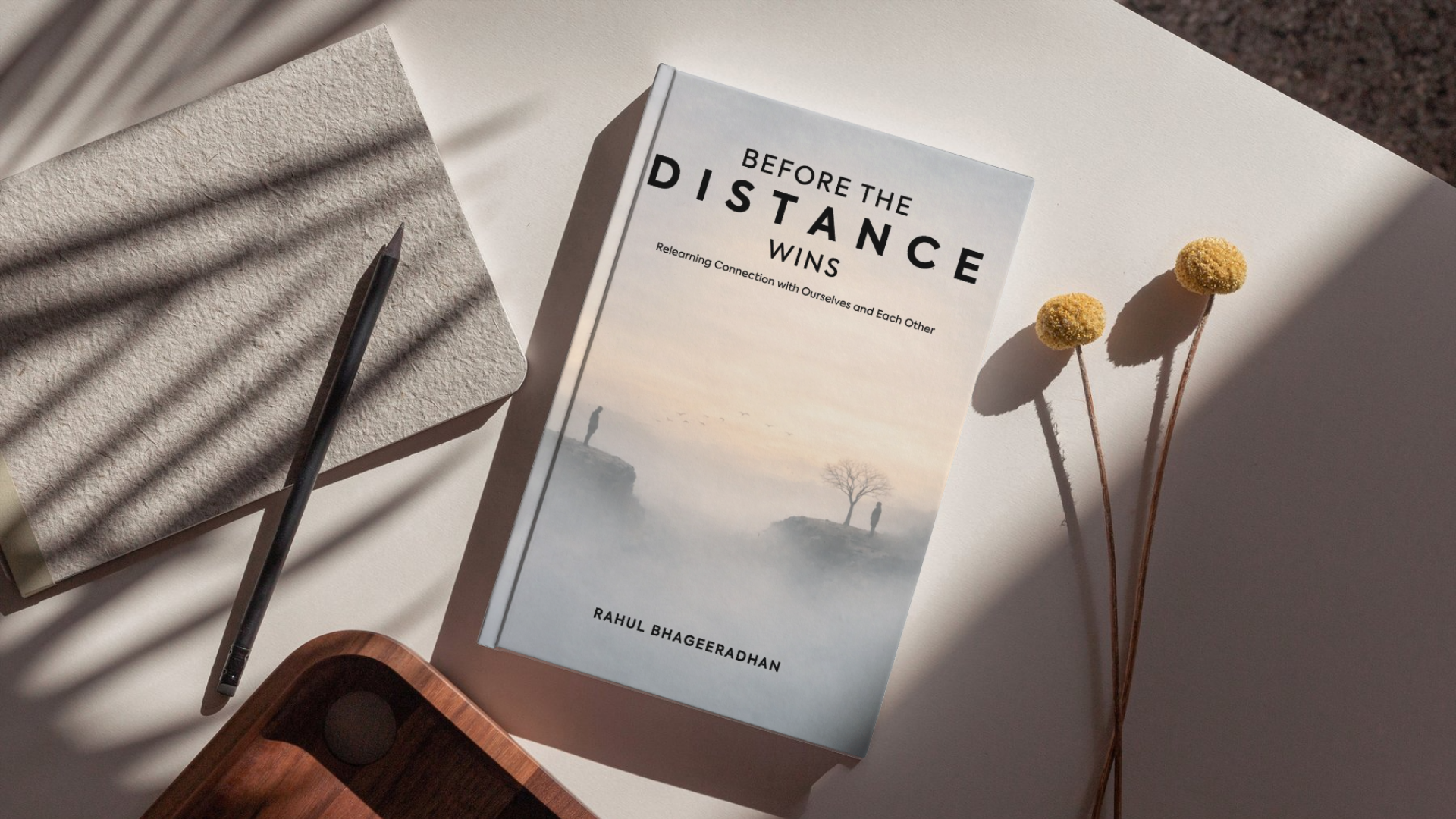
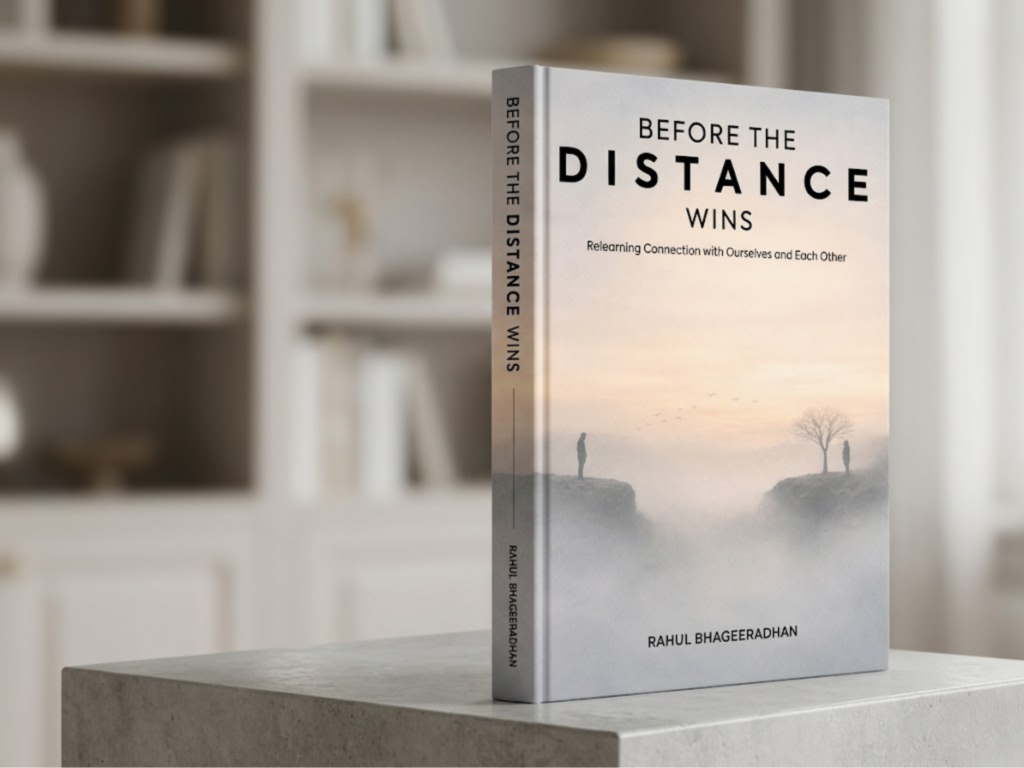
BEFORE THE DISTANCE WINS
Relearning Connection with Ourselves and Each Other
This is for anyone who has ever felt close, yet distant. Seen, yet misunderstood. Connected, yet alone.

ABOUT BOOK
Synopsis
There is a kind of distance that never announces itself. It doesn’t arrive with an argument or a diagnosis, a single conversation where everything changed. It settles the way dust settles — so gradually that by the time you notice it, you can’t remember when it began.
You may know it as the feeling of driving home from an evening that went well, warm, easy, good company, and sitting in the car for a few minutes before going inside. Not because anything was wrong. Because some part of you wasn’t ready yet to carry what you were carrying into the next room.
Or the room full of people you love that somehow leaves you more alone than the drive home did. The conversation that used to carry weight and now only stays on the surface. The quiet sense that somewhere along the way, you moved a little further from yourself — and in doing so, a little further from everyone else.
This book draws on two decades spent at the intersection of connective technology and human disconnection, and on research across attachment theory, neuroscience, and clinical psychology. But it is not a research book, and it is not a book of quick fixes.
It is an invitation. To notice, gently and honestly, before the distance wins.
BEFORE YOU BEGIN
What This Book Won’t Do
This isn’t a book of steps, frameworks, or strategies for better connection. It won’t ask you to have different conversations, practice new habits, or become someone you haven’t yet been.
It will only ask you to notice.
Because the distance that hasn’t been seen cannot be crossed. And the distance that has been honestly seen, without blame, without urgency, with whatever gentleness you can manage, has already, in some small way, begun to close.

A Quiet Recognition
You Might Know This Feeling Already
You keep in touch with everyone and still feel, some evenings, entirely unreached.
You’ve noticed a conversation end with something unfinished, even though nothing was said wrong.
You’ve felt the particular tiredness of saying you’re fine, again, when something underneath was not.
You’ve caught yourself moving through a life that looks, from the outside, complete — and wondered, quietly, when you started watching it instead of living it.

“There is a form of distance that grows without announcement. It doesn’t arrive through crisis. It settles in the way dust settles, so gradually that you can’t point to the moment it began. You only notice it later, when you run your finger along a surface and realise how long it has been since you really looked.”

If any of this sounds familiar, you’re exactly who this book was written for.
A NOTE FROM RAHUL
Why I Wrote This Book
I didn’t set out to write a book about disconnection. I set out to understand something I kept noticing, in conversations, in relationships, in quiet moments with people who seemed, by every visible measure, to be doing fine.
I recognized it because I’d felt it myself. Not a crisis, I want to be clear about that. Nothing dramatic had gone wrong. I was functioning well, showing up where I was expected, useful in the ways I knew how. But somewhere underneath all of that, something had gone very quiet.
There was a particular kind of tiredness that kept showing up. Not the tiredness of overwork, though that was often there too. Something underneath it. A flatness. Going through the motions of closeness without quite arriving at it.
The more I looked, the more I understood: this wasn’t a personal failing. It was the ordinary result of learning to function in a world that rarely asks what the human nervous system actually needs to feel safe and connected.
I came to this from two directions at once. Professionally, I worked in the industries built to connect people: AI, digital transformation, automation. I watched that world produce some of the most quietly disconnected people I’d ever met. Myself included.
And in Ayurvalley, the healing practice I founded, I kept meeting the same person, someone who understood exactly what they needed and still couldn’t quite reach it.
That gap, between knowing and feeling, is what this book is trying to close. It isn’t an academic book. It’s a human one, I hope.
A note on how to read it: slowly, if you can. These chapters aren’t meant to be consumed and moved past. They’re meant to be sat with, the way you might sit with a conversation that opened something in you.
There’s no transformation promised here. Only the small, real possibility of becoming a little more honest with yourself about how you’ve been living.
In my experience, that’s where everything else begins. — Rahul
A NOTE ON PACE
How to Read This Book
Each chapter closes with a short reflective pause, a few lines meant to be read slowly, set down, and returned to rather than answered right away.
There’s no destination to reach. Only the small, real experience of your own recognition, arriving at whatever pace it arrives.
THE JOURNEY THROUGH THE BOOK
Five parts, one way back
A walk through of what is covered
Remembering What Was Natural
What connection looked like before we learned to perform it.
Returning to the Inner World
Listening to what’s quiet inside, and what the body already knows.
Understanding Our Protective Patterns
How we learned to protect instead of connect.
Choosing Presence Again
Staying, even when leaving would be easier.
The First Step Back
The first small, ordinary act of reaching back.
“Connection does not ask for perfection. It never did. It asks only for the real thing, whatever that is, wherever it currently is, in whatever condition it happens to be in today.”
BEFORE YOU GO
You Are Not Alone In This
The distance is ordinary. It forms in ordinary lives, through the ordinary process of learning to function in a world that rarely asks us to slow down long enough to feel what is actually present.
Everyone who reads this book will recognize some version of that. The recognition isn’t a sign that something is wrong with you. It’s a sign that the capacity for genuine connection is still alive in you — still asking, still hoping to be met.
You can turn back. Not to who you were, but toward what you’re still capable of.
Go gently. Go honestly. Go toward the people who matter, and toward the version of yourself that knows how to be with them. That’s enough. It’s, in fact, everything.

Get the book
If any of this found you, the rest of the book is waiting.
Available in paperback and ebook.

About the Author
Rahul Bhageeradhan has spent more than two decades at an unusual intersection: the industries built to connect people, and the practice of understanding why connection so often fails.
As a senior leader in artificial intelligence and digital transformation, he watched, at close range, how the most connected industry in the world could produce some of the most quietly disconnected people he had ever met. He recognized what he was watching, because he had watched it in himself first.
In 2008, he founded Ayurvalley, an Ayurvedic healthcare practice now operating across multiple locations in India. Over fifteen years of building it, he worked with people who understood precisely what they were carrying and still couldn’t quite reach the place where something changed, the same gap his research into hypnosis and the architecture of the mind kept circling back to: why we already know what we need, and still find it so hard to change.
“The mind does not create distance out of indifference. It creates it out of intelligence. The same mechanisms that protect us from pain also protect us from closeness.”
Before the Distance Wins is his first book. Rahul grew up in Kerala, India, and now lives in Dubai with his family.